


The Marl Crust in Lough Carra is also known as Krustenstein but what is it exactly?
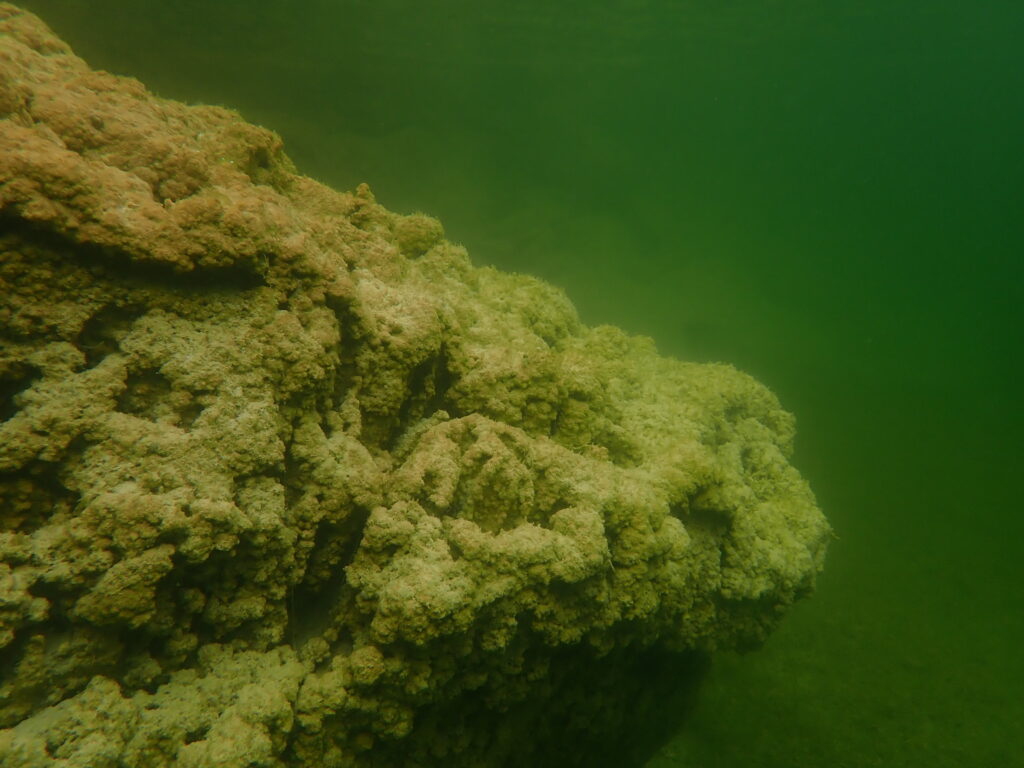
Marl Crust – is a mix of organic (mostly cyanobacteria along with algae and microscopic animals) and inorganic (mainly grains of calcium carbonate) material that gradually forms a spongy layer on rocks and the lakebed in low nutrient, limestone lakes such as Lough Carra.
What does it look like?
Most people will notice it as a whitish, quite slippery layer on the rocks on the lakeshore.
If you cut into a slice of marl crust you can see a green layer just beneath the surface. Below this will be a soft, whitish, crumbly layer, made up of quite fine grains.
What are these layers made of?
Green Layer – This is the living layer of the marl crust and is made up of a community of tiny life forms. The majority of these are cyanobacteria, ancient organisms which can grow as filaments, clusters of cells, or interwoven masses, depending on the species. It also contains various sorts of algae and animals.
Many of these animals are microscopic, such as the nematode worms that writhe and slither among the marl grains, but bigger animals live in these crusts too. Because thick crusts often have cavities or hollows, animals such as beetles, flatworms, and caddis fly larvae can be found living in them. A particularly rare beetle, called Ochthebius nilssoni, has been found living on Lough Carra crusts making Lough Carra one of the few places in the world where this species can be found.
These marl crusts also contain a lot of small grains of calcium carbonate (the main mineral that makes up limestone). In the upper layers of crust, these grains are bound together by many strands of the filamentous cyanobacteria. It is important for the right combination of low nutrients, clear waters, cyanobacteria and limestone bedrock to exist in order for marl crust to exist.
White layer – The non living layer of the marl does not contain any cyanobacteria, algae or other living organisms that need light which does not penetrate deep into crust. Instead the white layer it is made up of inorganic matter such as small grains of calcium carbonate and other particles such as sand grains or pollen grains that get stuck in the crust as it grows. This means that the lower parts of crusts are more loose and crumbly in texture.
Why are they under threat?
Due to human activities the maintenance of a low nutrient environment in the lake is becoming increasingly challenging. Increases in nutrients (especially phosphorus and nitrates) promotes algal blooms in the water which impacts the water clarity and the algae will also grow on the crust itself which leads to the crust gradually degrading and falling apart.
You can find more detailed information on marl in this helpful booklet by Philip Doddy. It will help you understand, how marl crusts are formed, what they can tell us about Lough Carra and other places you can find marl crusts.
You can also find more details in our online information booklet on marl crusts.